


You are about to read the six edition of Close Reading, a dispatch of literary obsessions, published by Woolgather. Each edition features a guest writer who shares one word, one quote, one poem, one book, and “one other thing”. This edition is by Madeleine Watts, a writer of novels, stories, and essays.
Originally from Sydney, now based in Berlin, Madeleine’s debut novel, The Inland Sea, was shortlisted for the 2021 Miles Franklin Literary Award and the UTS Glenda Adams Award for New Writing. Her second novel, Elegy, Southwest, was published in February 2025 by Simon & Schuster (North America), Pushkin Press (UK), and Ultimo Press (ANZ). It has been shortlisted for the Christina Stead Prize for Fiction and longlisted for the ALS Gold Medal.
Her writing has been published in Harper’s Magazine, The Baffler, The Believer, The White Review, Literary Hub, The Paris Review Daily, Los Angeles Review of Books, The Irish Times, Guernica, Meanjin and The Lifted Brow, among others.
She has an MFA in Writing from Columbia University in New York, and graduated from the University of Sydney with a B.A. (Hons I) in English Literature. She has taught at Columbia and Johns Hopkins Universities, the Berlin Writers Workshop, Catapult, and the Center for Fiction.
In this edition, Madeleine shares words of understanding, communication, the pleasure of bookstores, and the connections between body and mind.
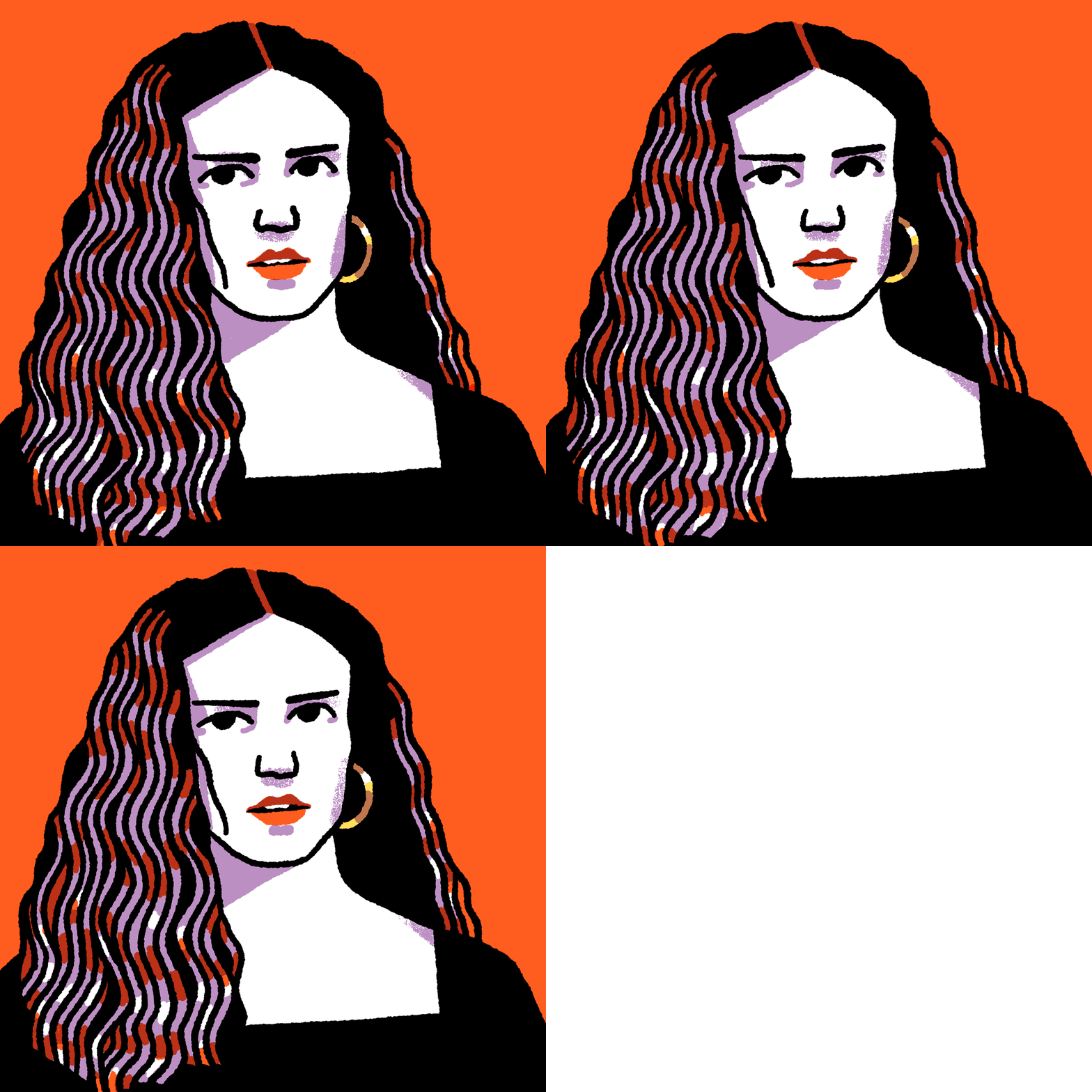
Illustration by Lachlan Conn
One Word:
Genau
I moved to Berlin a couple of years ago and started learning German in preparation a year or so before that. German is known for having all sorts of long, exhausting, hyper-specific compound words, but the word I like best is ‘Genau’. It can be both adjective and adverb. It can mean something like ‘correct’ or ‘exact’ but it can also be a kind of positive affirmation in the way we might use ‘Word’ or ‘Sure’. It is a word of agreement and a word of understanding and a word of mild positivity and a word that keeps the conversation ticking over, and you can pretty much ‘Genau’ your way through most everyday German conversations. It collects up twenty or thirty different variants of words we have in English and collapses them all into one ‘Genau.’
One Quote:
Woman in a Green Mantle
“I hate writing. Writing is a sickness, a neurosis, a mania. Philip Larkin says somewhere that the urge to preserve is the basis of all art. I’ve had it up to here with rhetoric about art: but the urge to preserve – I understand that. I’ve been captive of it for most of my adult life.”
This is something Helen Garner wrote in her essay ‘Woman in a Green Mantle,’ a piece which is mostly about her lifelong tendency to keep notebooks and diaries. I have remembered it since I first underlined it when I read it at twenty-two, and I often find I mutter it to myself as I make my way towards my desk.
One Poem:
The First Body is the Water
My favourite book of poetry published in the last decade is Natalie Diaz’s Postcolonial Love Poem. It contains some incredibly gorgeous love poems – one of which was used as part of my wedding ceremony to my husband – but the poem I have gone back to the most often is called ‘The First Body is the Water.’ It is both about the Colorado River and Diaz’s spiritual relationship to that body of water as a Mojave woman, but also about language and the physical, desiring body. It’s a poem that sometimes reads as an essay, before breaking into lyric just when you feel it begin topull away. For instance:
“This is not juxtaposition. Body and water are not two unlike things—they are more than close together or side by side. They are same—body, being, energy, prayer, current, motion, medicine.
The body is beyond six senses. Is sensual. An ecstatic state of energy, always on the verge of praying, or entering any river of movement.
Energy is a moving river moving my moving body.”
One Book:
The Years
For six years when I lived in New York I worked at the bookstore McNally Jackson, and I developed a collection of books I found myself foisting upon others and giving most often as gifts. They included Derek Jarman’s Modern Nature, Doris Lessing’s The Golden Notebook, Deborah Levy’s The Cost of Living, and Maggie Nelson’s Bluets, but the one I’m picking out here is Annie Ernaux’s The Years. It is, I think, the best of Ernaux’s books, one which tells the story of an entire generation – politically, economically, socially – by telling the story of her own life. It is an incredible feat of life writing, and it’s one of those books which I experience as consolation every time I read it, and which nearly always makes me want to get up from the chair and start working
One Other Thing:
The Second Body
For the last few years, I have taught a lot of creative writing classes centred around nature and climate change, and I always assign Daisy Hildyard’s The Second Body either in excerpt or in full. ‘The Second Body’ is an incredibly useful concept, particularly for artists and writers. Hildyard talks about the ways in which we inhabit both our first bodies – the one sitting here reading this, digesting food, scratching at a hang nail – and our second bodies, which might be thought of ecosystemic bodies, which connect us to every living thing on earth. Sometimes the first body crashes into the second body, and it’s those moments that I find myself encountering more and more in the last five years. Whenever I do, I am incredibly grateful to have Daisy Hildyard’s work to think with.