



You are about to read the twelfth edition of Close Reading, a dispatch of literary obsessions, published by Woolgather. Each edition features a guest writer who shares one word, one quote, one poem, one book, and “one other thing”. This edition is by Rachel Ang, an Australian writer and artist based in Naarm/Melbourne.
Rachel’s work has been published in international journals such as The New Yorker and kuš!, and Australian periodicals like The Age and Meanjin. Their new book, a collection of short stories in comics form titled I Ate The Whole World to Find You, is out now through Drawn and Quarterly and Scribe, and was shortlisted for an Ignatz Award.
Rachel is the winner of the 2024 Neilma Sidney Short Story Prize, for their short story Thalassophobia. In 2019 Rachel was the recipient of a Silver Medal from the Comic Arts Awards of Australia for their graphic novella, Swimsuit; as well as the Woollahra Digital Literary Prize (Fiction) for their comic Toot Toot, originally published by Going Down Swinging.
In this edition, Rachel shares words of motherhood, family, language, and change.
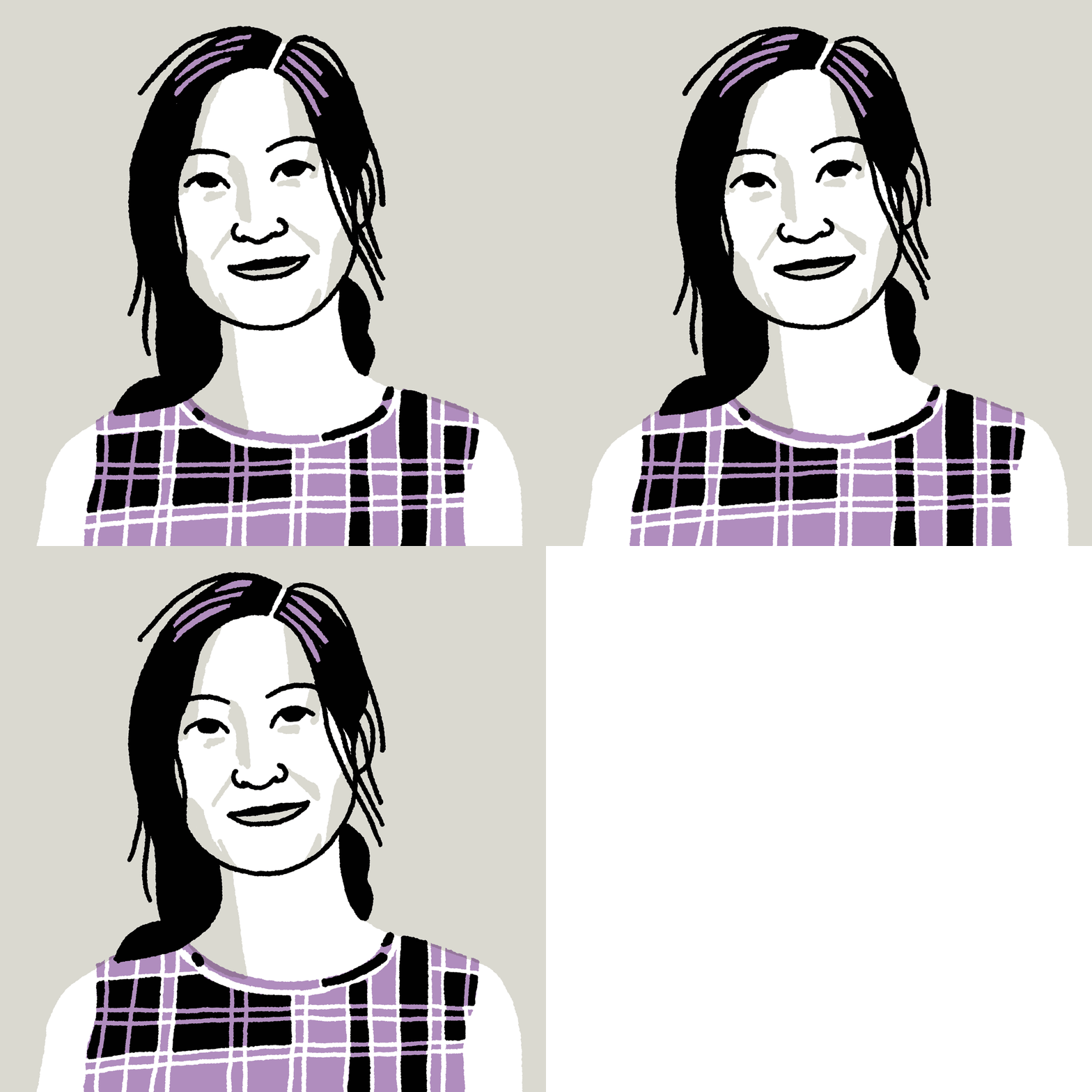
Illustration by Lachlan Conn
One Word:
οικογένεια
I have chosen the word οικογένεια, which is the Greek word for family. It is the root of many English words, including ecology and economy. I have been thinking a lot about this, of how words, ideas and people often share a birthplace but then diverge, drift and mutate into viewpoints that seem to be at war with one another.
One Quote:
From Andy Warhol
Many years ago I wrote down this quote from Andy Warhol, and this morning I rediscovered it: They always say time changes things, but you actually have to change them yourself.
It seems to me that we are being dictated to about what our present and future should look like, that it is inevitable that AI will demolish our abilities to read and think, and an inescapable fate that our world should be sundered by wars and genocides and violence. We are being cowed into a passive position of accepting these shitty realities, and I take a lot of heart and encouragement from friends around me who are organising, building, forming community and fighting for a less cruel world.
One Poem:
Small Wire
I love these lines from the last stanza of a poem by Anne Sexton called Small Wire.
As its been said:
Love and a cough
Cannot be concealed.
Even a small cough.
Even a small love.
One Book:
But Won’t I Miss Me
I recently read Tiffany Tsao’s new book, But Won’t I Miss Me, and it really shook me. The novel follows a new mother called Vivi through an alternate reality in which birth endows mothers with superhuman powers to withstand the challenges of the postpartum period. Sounds like a dream, but the mode through which these powers are obtained is truly macabre: pregnant women gestate not only their child but a tiny foetal version of themselves. After the baby is born, the tiny replica emerges, growing immediately into an identical woman who tears apart and consumes (!) the old husk of herself, and takes her place, her memories, her life and her newborn child. In the world of this novel, rebirth (as the process is referred to) is accepted as a normal and necessary part of parturition, an afterthought to the main event of the baby’s entrance into the world. But Vivi doesn’t want to be eaten and replaced. Her fear of rebirth is treated as unusual and unhealthy by those around her and seems to manifest in disaster: Vivi emerges from rebirth weakened rather than supercharged.
I found the first half to be an interesting and clever scifi, but then at the midway point came a twist that completely blindsided me. When Vivi learns what went wrong during rebirth, it completely rewrites her life and drives her to some extreme, perhaps insane, places. This was such a strange and gripping novel, propelled by maternal and familial love in all its dark, jagged, ugly, and glorious forms.
One Other Thing:
Children’s Books
In this season of life I’ve mainly been reading children’s books. It’s a sweet joy to encounter books alongside my child, and a great shock to return to the books of my early years and rediscover them anew, from the perspective of a parent. For example, it is a little discomfiting to revisit books like Babar, Charlotte’s Web, or Bambi, and see that the maternal figure must die, or sacrifice herself completely like The Giving Tree, in order for the boy’s story to unfold, for the child (or pig etc) to become a man. As a child I identified with the young male character and didn’t think about the mother at all. Now that I’m a mother I can see that while a little girl may identify with the main character, the morality of these kinds of stories dictates that the female characters are fungible, we simply create the environments in which the heroes move, or serve as rewards for the hero to strive towards.
It has also been humbling to witness how opinionated my kid is, how children tumble out of the womb with all kinds of sensibilities and taste intact. Sometimes I’ll dismiss a book because I think it’s ugly or the illustration style is not to my taste, but he will love it. Other times I will present him with a book I consider to be a great classic, and it is rejected out of hand. Alas, it turns out I know nothing!