



You are about to read the eleventh edition of Close Reading, a dispatch of literary obsessions, published by Woolgather. Each edition features a guest writer who shares one word, one quote, one poem, one book, and “one other thing”. This edition is by Rick Morton, an Australian writer and journalist based in Paris.
Rick Morton is the author of four non-fiction books, including the critically-acclaimed bestseller One Hundred Years of Dirt (MUP) which was long listed for the Walkley Book of the Year and shortlisted for the National Biography Award. His latest book, Mean Streak (Harper Collins), is about this illegal and fake debt trap set by the Australian government, bureaucratic harm and the fight to put people back into policy. Mean Streak won three major literary prizes in 2025, including the Prime Minister’s Literary Award for Non-Fiction and the Walkley Book of the Year award.
As a Journalist, Rick is the senior reporter with The Saturday Paper and 2 x Walkley Award winner for his coverage of the Robodebt Royal Commission. Born and raised in Queensland, he now lives in Paris where he continues to investigate and write on policy and government decision-making that affects human beings.
In this edition, Rick shares words of biology, self-discovery, power, and language.
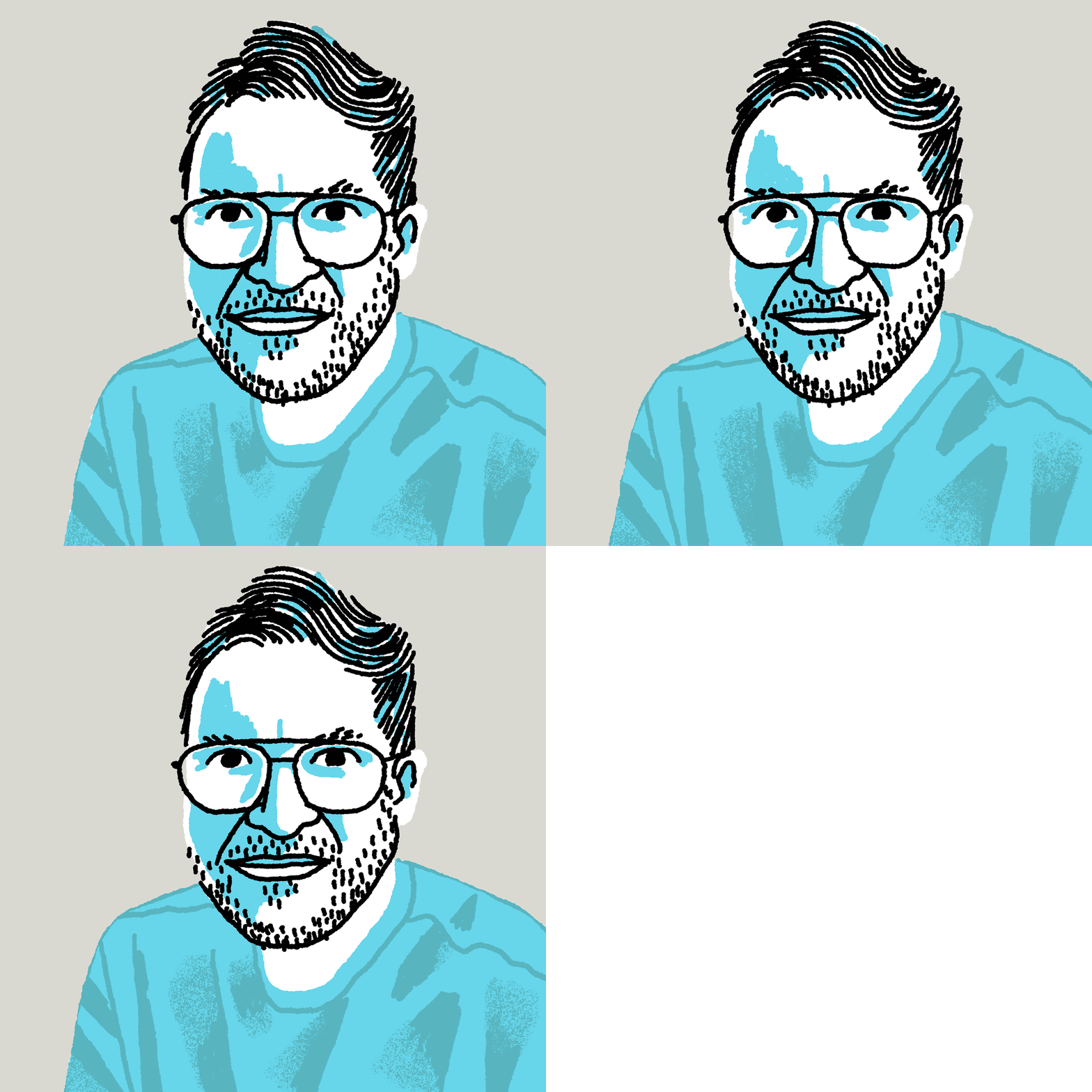
Illustration by Lachlan Conn
One Word:
Fissiparous
I love the way this word sounds. It has a real kind of hiss and colour to it that I adore. It also just feels good in the mouth, so to speak. Fissiparous: originally from biology, specifically cellular division, it is now used to talk about the tendency of things or people to divide into groups or factions. Perhaps not the most hopeful word, but boy is it fun.
One Quote:
Jenny Diski
“My eyes were made of diamonds, not the glitzy sort that sparkled and shone, but the implacably black kind that knew the worth of concealed things (some called them ‘your coal-black eyes’). Those eyes radiated the truth of the matter to anyone who dared look at them. And the darkness drew in the world and showed me what the world could do and was doing. Those eyes picked out the lies, the faults, the vanity, the hypocrisy and put them in their mirrored compartments and twisted them like a kaleidoscope, not into shards of chaos pretending to make sense, but into the actual truth, all unknitted and unravelled into what the fuck was wrong with everything. And what was wrong with everything was people and their need to do all those things that made the world go round. The answer of course was that everyone told lies. All kinds, big, small, monumental, trivial, world-shattering, mind-shattering, hateful, loving lies. No one tells the truth – that is the privilege of 18-year-olds. No one knew it, but there was the reason for the belligerence on my face. It was the visual representation of the fact that they’d never get one over on me again”.
— Jenny Diski, London Review of Books.
I first read this piece from Jenny Diski when it was published in mid-2015, around the time I was experiencing a somewhat seismic breakdown owing to the complexities of childhood. Diski revealed something to me about myself, not necessarily anything edifying, in that I thought I had some kind of superpower of insight. I did not and it took a long time to learn otherwise. I still think about these lines a lot, however, and what it means to experience the crack of revelation in a single moment; what a gift it is.
One Poem:
Kindness
Before you know kindness as the deepest thing inside,
you must know sorrow as the other deepest thing.
You must wake up with sorrow.
You must speak to it till your voice
catches the thread of all sorrows
and you see the size of the cloth.
— From Kindness by Naomi Shihab-Nye
A gentle wallop of a poem, this has long stayed with me. The ease with which Shihab-Nye offers such a profound insight feels almost like magic. Kindness, the real version of it — that is, not performative, not shallow nor strategic — is twinned to sorrow. Those who know something of sorrow, having communed with their piece of it, develop a sense for just how vast it is, how many shapes it might take and in whom. Kindness is the natural result of this interrogation of sorrow. How could it be otherwise?
One Book:
Catch-22
Long before I started covering the various contortions of political and civil bureaucracies professionally, and certainly well before my work reached its absurd zenith in the mathematically illogical and illegal Robodebt scheme, I have been fascinated by the way large systems control people. It started in high school with Douglas Adams in the very first chapter of The Hitchhiker’s Guide to the Galaxy when poor old Arthur Dent is told the plans to demolish his house were put on display by council in a cellar with no stairs, no lights and at the “bottom of a locked filing cabinet stuck in a disused lavatory with a sign on the door saying ‘Beware of the Leopard’.” Most of the fiction I read in my teens and early 20s spoke to the comical, devastating power of these systems — they were often bureaucracies — with Kurt Vonnegut and Kafka being notable examples.
However no book has revealed the world to me quite so clearly as Heller’s Catch-22. As funny, disturbing and downright maddening as the plot may be — an airman is trying not to die during World War Two while his military commanders keep arbitrarily raising the number of dangerous bombing missions whenever he thinks himself done — Heller is writing about real life. He sees things plain. In its quotidian, modern sense, absurd is usually a word used to describe something that bears no resemblance to reality. But Heller’s gift, like Camus’, is knowing that the absurd is reality. It’s the stuff all around us; the people in charge. They are people, like us, and like us they are not psychologically contiguous. Such a fact is what makes some systems so powerful but it is also what makes them weak.
One Other Thing:
Speaking French
I have lived in Paris for the past year, and will remain here for a while it seems. After arriving with a broad enough French vocabulary for somebody who has never taken lessons — but very little in the way of conversational skills — I have taken to tutoring with my teacher Jean-Yves each week. He is very French, in that each time we meet we end up having these big philosophical discussions about totalitarian regimes and the influence of technology on the lives of people. I learned German for a decade as a school student and became almost fluent before losing it all to some dark corner of my mind when my university did not offer the language. Sometimes when I try to speak French, the German barges in. Phrases I’d thought long forgotten are suddenly escaping from me via my vocal cords. This may seem obvious to anyone raised in families from non-English speaking backgrounds, like so many in Australia, but the revelation of learning another language and how it both buttresses and disputes our own native tongue is such a gift. Of course, as the writer Alexandre Dumas realised, so much of English is just French ‘but badly pronounced’. Living on the edge of another tongue is quite thrilling, and it has expanded my own mind and writing, even as I often struggle to remember whether apartment has one ‘p’ or two.