


Welcome to the fourth edition of Close Reading, a dispatch of literary obsessions, published by Woolgather. Each edition features a guest writer who shares one word, one quote, one lyric, one book, and “one other thing”. This edition is by Yves Rees, an award-winning historian, podcaster, and writer based in Naarm/Melbourne.
Dr. Rees (they/them) is a Senior Lecturer in History at La Trobe University, co-host of Archive Fever history podcast, and founding editor of literary journal LANTANA. They are the author of Travelling to Tomorrow: the modern women who sparked Australia’s romance with America (NewSouth, 2024) and All About Yves: Notes from a Transition (Allen & Unwin, 2021), as well as co-editor of Nothing to Hide: Voices of Trans and Gender Diverse Australia (Allen & Unwin, 2022) and Transnationalism, Nationalism and Australian History (Palgrave, 2017). Their essays and criticism have been published in the Guardian, The Age, Sydney Review of Books, Australian Book Review, Meanjin, Griffith Review, Crikey, and Overland, among other publications. They are also co-editor of the journal History Australia and guest curator of the 2026 Trans Book Festival.
In this edition, Yves shares words of resistance, empowerment, and the search for hope and community in times of despair.
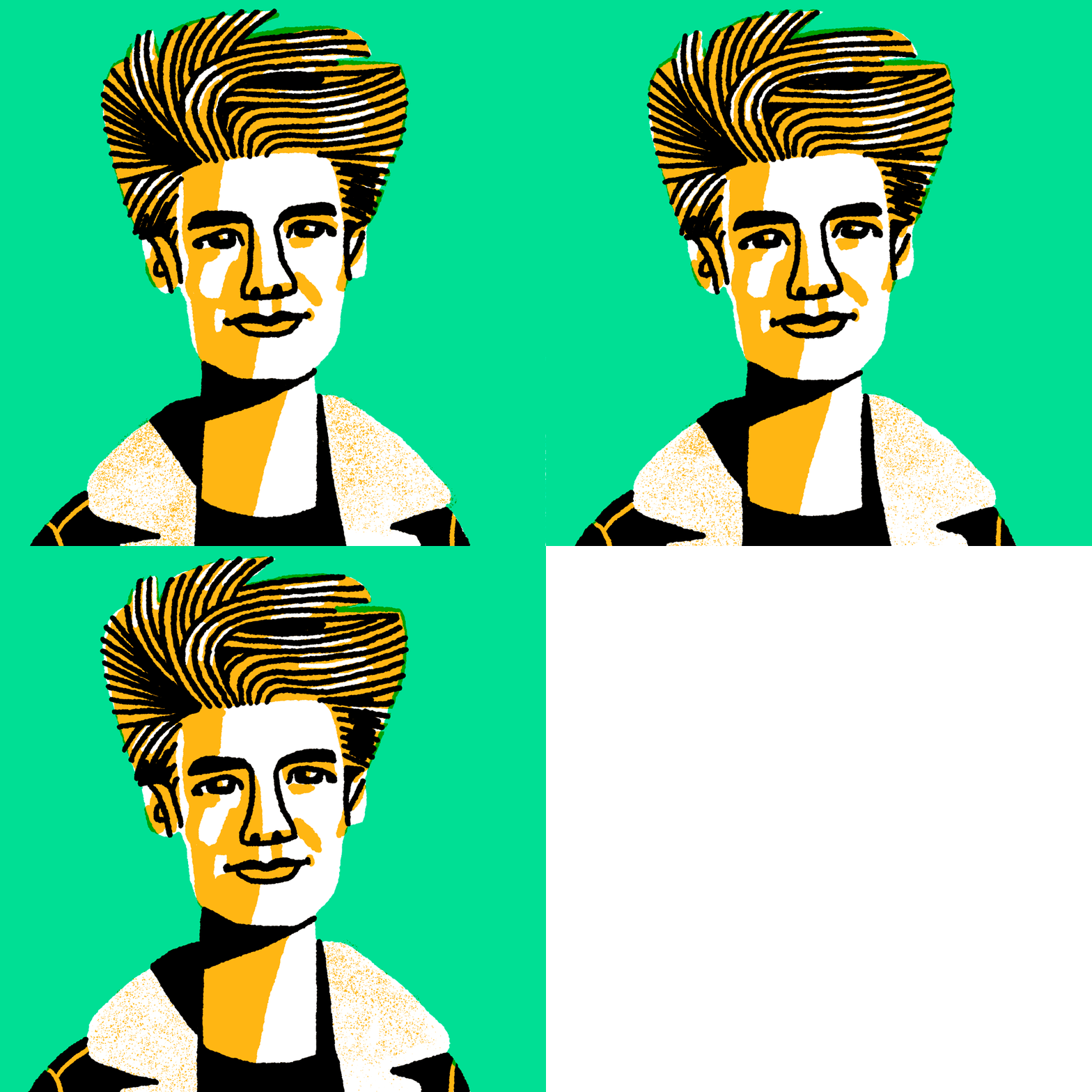
Illustration by Lachlan Conn
One Word:
Ungovernable
In recent years, I’ve chosen a ‘word of the year’ in lieu of new year’s resolutions. In 2024 it was community, in 2025 it was unhinged, and in 2026 it’s ungovernable. I landed on this word after hearing Evelyn Araluen read the poem ‘Change Agent’ from her incendiary new collection The Rot. About halfway through, the poem reads: “Be ungovernable and / aligned with orcas. The work is / relational and forever”.
For me, the directive ‘be ungovernable’ evoked the twofold project of resisting external oppression but also refusing the anticipatory compliance that oppressive powers rely upon to do their work. It’s a word and a concept that reminds me to kill the cop and the coloniser in my head. I’m not there yet, not by any means, but it’s a beautiful thing to be reaching towards.
One Quote:
Rebecca Solnit
Over the last decade, as I’ve grappled with the implications of polycrisis and collapse, American essayist Rebecca Solnit has been a guiding light. In particular, I often return to her words from the 2004 collection Hope in the Dark: “Stories trap us, stories free us, we live and die by stories’, with the consequence that ‘the change that counts in revolution takes place first in the imagination”.
As a historian and as a writer, I believe in those statements with every fibre of my being, and they articulate why I’ve chosen to dedicate my life to the work of storytelling. It’s the quote I come back to on days when playing with words on a screen feels the most indulgent and trivial thing imaginable.
One Poem:
Andrea Gibson
Andrea Gibson, a nonbinary poet who died of cancer in 2025, was one of those wordsmiths whose deceptive simplicity helps you see the world anew. In November 2024, on the day after Trump was re-elected, Gibson posted some words that dragged me up from the the abyss:
“If we have nothing / but each other / we have so much”.
That vision of abundance kept me going that dark day, and it continues to provide succour whenever I fall into the deficit mindset encouraged by our capitalist overlords.
One Book:
One Day, Everyone Will Have Been Against This
Omar El Akkad’s One Day, Everyone Will Always Have Been Against This is a howl against the genocide in Gaza that rearranged my soul. With devastating precision, El Akkad diagnoses the world’s failure to stop (or even acknowledge) this live-streamed slaughter as a larger indictment of Western liberalism. ‘This is an account of a fracture,’ he writes, ‘a breaking away from the notion that the polite, Western liberal ever stood for anything at all.’
One Other Thing:
Love in a Fucked Up World
For me, as for so many of us, the question of the moment is: how to build a viable left? Or, in other words, how to stop the left eating itself? Increasingly, I’m drawn to thinkers who approach this question through the lens of interpersonal relationships and relational skills, with the logic that we need to get better at handling conflict and managing difference if we are going to work together.
One of my favourite thinkers here is trans lawyer and activist Dean Spade, who has been exploring these ideas in his new podcast Love in a Fucked Up World (based on the eponymous book). Spade is a serious intellectual and veteran organiser, but never takes himself (or anyone else too) seriously. His work gives me hope that we can shift away from cultures of cancellation and lateral violence, and instead build unstoppable coalitions.