


You are about to read the fifth edition of Close Reading, a dispatch of literary obsessions, published by Woolgather. Each edition features a guest writer who shares one word, one quote, one poem, one book, and “one other thing”. This edition is by Zoë Sadokierski, a writer, designer, and educator based in Sydney.
In addition to her creative work, Zoë Sadokierski is associate professor in Visual Communication at the UTS School of Design. Her practice-based research explores ways that visual communication – particularly illustrated nonfiction, data storytelling and anarchival collage – can be used to engage audiences with complex scientific and cultural issues. She is a former president and founding member of the Australian Book Designers Association. In 2015 Zoë established Page Screen Books, an independent publisher of artist’s books and visual essays. Her works on paper and artist books have been exhibited and collected internationally. Her book Father, Son and Other Animals (Cordite, 2024) explores climate change and species extinctions through the lenses of parenting and creative practice.
In this edition, Zoë shares words of nature, technology, creativity, literacy, and the importance in finding perspective.
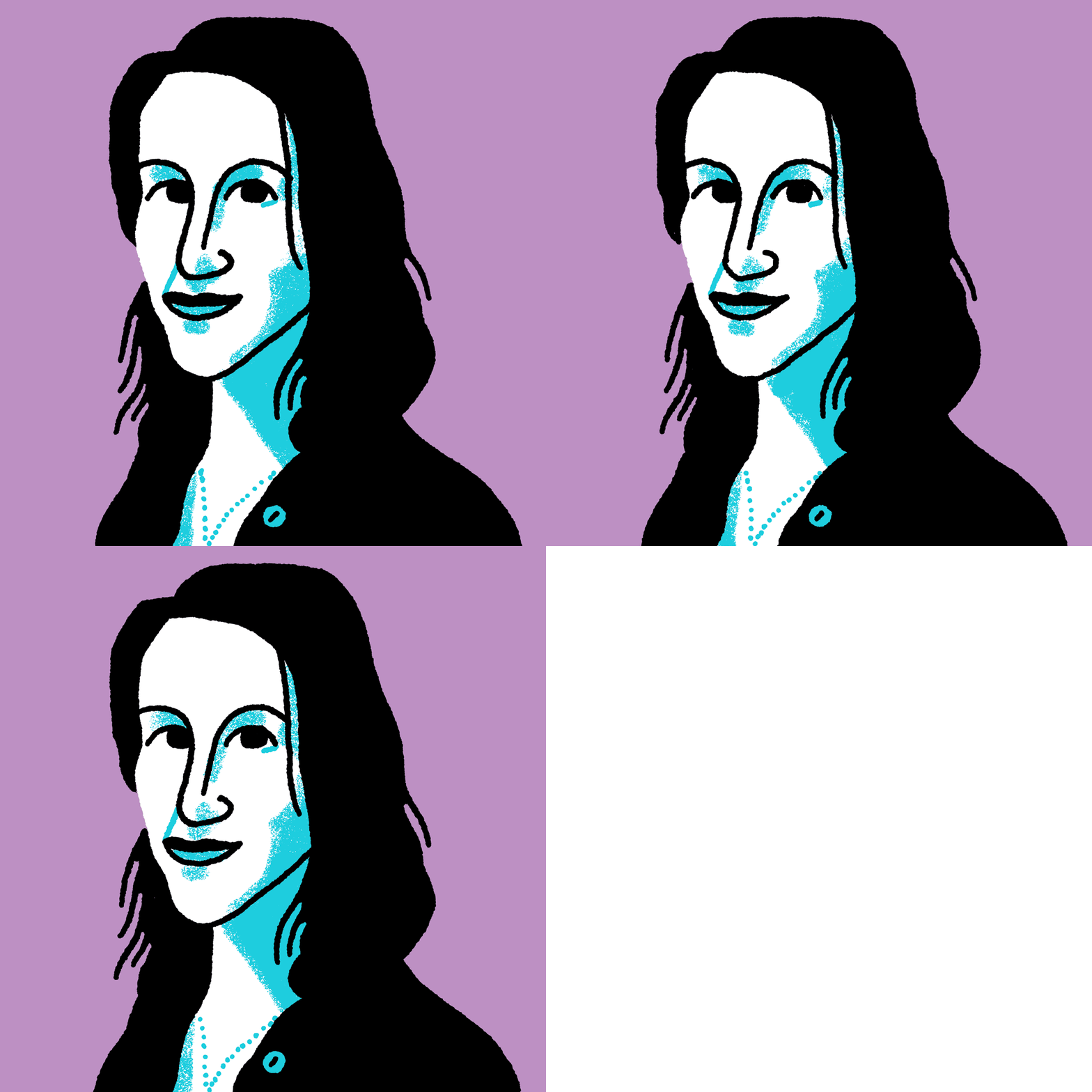
Illustration by Lachlan Conn
One Word:
Anarchival
For the past few years, I’ve been playing with visual material from natural history collections (illustrations, photographs, manuscripts) to think through species extinctions and other consequences of humans meddling with the natural world. I’ve been manipulating and recreating archival images from science museums, and writing about this process, to generate counternarratives: stories that challenge or extend existing historical accounts, particularly around our complicated relationships with other animals. This can be described as an ‘anarchival’ practice.
In a nutshell, those of us in positions of privilege (such as academics) need to bring more anarchy into the systems we inhabit. We need to challenge dominant narratives, by bringing marginalised perspectives into public discourse. This isn’t a solo project. Increasingly, I’m less interested in being The Author or The Designer. I’ve been doing a lot of my thinking – reading, writing and making – with people who amplify what I could do alone: Monica Monin, Andrew Burrell, Ceridwen Dovey, Timo Rissanen, Thom van Dooren, Mackenzie Cooley, to name a few. Also, my students, many of whom are significantly more anarchic than me, which I love.
I’m going to cheat and include a quote here, even though there’s one below. In Staying with the Trouble, Donna Haraway writes:
“It matters what matters we use to think other matters with; it matters what stories we tell to tell other stories with; it matters what knots knot knots, what thoughts think thoughts, what descriptions describe descriptions, what ties tie ties. It matters what stories make worlds, what worlds make stories.”
Collaboratively seeking out new ways to trouble, investigate, translate, story (no one word will do) the world around us, we ensure that however history plays out, there will be nuanced records of this time and the many ways we understood and resisted the multiple Troubles we’re in.
Which segways into...
One Quote:
Margaret Atwood
“People use technology to only mean digital technology.
Technology is actually everything we make”.
— Margaret Atwood
If one more person asks me whether I think creativity is about to die because of AI, I might die.
To be clear, I’m not Anti-AI – that ship has sailed. I just don’t want to engage in more uninformed banter. Technology is a tool, and how we wield that tool is what matters. How we critique who makes, owns, permits access to and is held accountable for AI tools matters.
Now is the time to read beyond headlines, forensically check credentials of writers and sources, deliberately recalibrate our algorithms to disrupt our echo chambers, seek out trusted voices. To become part of the conversation that extends beyond repeating the – often hilariously – horrifying clickbait and conspiracy fodder meme-ing around. The cluster of AI technologies is evolving at a terrifying pace, and there isn’t a short cut to keeping up. It will take careful, calibrated attention and strategic collective action, at a time when our attention spans are diminishing and we are overwhelmed by mis/information. This isn’t to say we shouldn’t relish the dark humour and schadenfreude of the fodder – the CEO who asked her AI agent to delete unnecessary emails and it trashed her entire account, the AI-only social media platform that spawned AI-religions/hacking each other/complaining about human owners – but these should be read as cautionary fables. Most, if not all, have since been revealed to as human-driven interactions. Again: those wielding the tools.
Where I see hope is a return to the valuing craft. To appreciating the relationships between the humans involved in creative work. The brief joys and longer sorrows of creative labour. Projects like this one – about sharing process and inspiration amongst communities of practice. I don’t think this is naive optimism. It’s a recalibration of how we value creative labour and the work that results from it.
To top and tail with Atwood:
‘Ignoring isn’t the same as ignorance, you have to work at it.’
One Poem:
14 Breaths
“change rushing up
from deep down
where time stills”
From 14 Breaths, by Ross Gibson and Kathryn Bird and A Published Event. A limited edition publication, with 14 poems printed on thick card, presented in a box with 14 Haku-un White Cloud incense sticks in a Borosilicate tube, a clay incense holder and Tasmanian oak card stand. The box transforms into a shrine to display one card and burn one stick at a time, to remember Ross. Like many in Sydney (and beyond), I found in Ross a mentor whose influence continues to define who I am as a writer, and how I am as an academic. I’m part of the Social Glue, a collage group established by Kathryn, who once told me Ross said: “above all else, I value kindness.” I think about that all the time.
One Book:
The Art of Looking Sideways
I bought Alan Fletcher's The Art of Looking Sideways as an undergraduate. I no longer own much from that time, but this book endures. Described as "a primer in visual intelligence, an exploration of the workings of the eye, the hand, the brain and the imagination" it is a treasure trove for working across word and image, finding creative inspiration in the world around us, and a reminder of the importance of wit in translating thoughts into stories – written and visual – for others to enjoy. Every time I open it something new reveals itself. It's also the perfect height to elevate my laptop for a video calls, which keeps it close to hand.
One Other Thing:
Observation Apps
Seek by iNaturalist is an app that (usually) identifies plants and animals, using your phone’s camera. The spider at head-height between the washing line and bins is a Heptagonal Orb-weaver, Gea heptagon. Similarly, the SkyView app maps what's going on overhead. Directly above me right now are Pluto, the Tucana constellation (looks like a toucan), the inactive observation satellite OKEAN-3 and the SL-8 Rocket Body (a fragment of a then-USSR rocket launched in 1971). Perspective is important.